The participation of the most prestigious institutions worldwide on Education and eLearning, the presence of well-known experts on the subject, the possibility of seen published your research in some of the better specialized journals, and to the chance to take part of an International Network about Educational Technology, are some pillars of this Congress that represent an opportunity to foster Educational Technology research
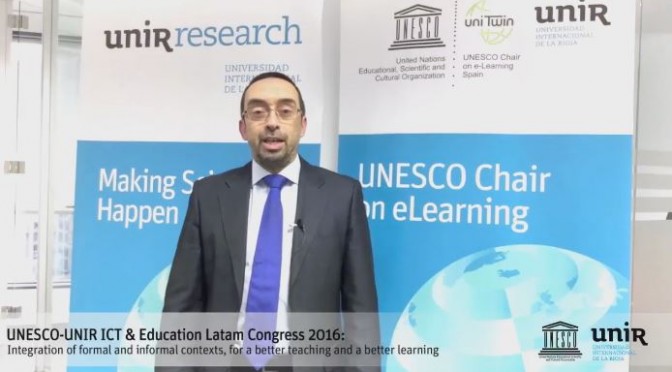
The UNESCO-UNIR ICT & Education Latam Congress will gather the global experts on Educational Technology, from institutions like UNESCO, ICDE, EDEN, TELEARC or UNIMED, around how to combine informal and formal learning. This topic “is a global concern for the academic community and policy makers around the globe”, according to Daniel Burgos, Vice-Chancellor for Research and Technology (UNIR Research, //research.unir.net), Director of the UNESCO Chair on eLearning and the ICDE Chair in Open Educational Resources, and Congress General Chair.
“The chance for a researcher to present his outcomes to an international audience under the UNESCO umbrella is remarkable”
Logo for UNESCO-UNIR ICT & Education Latam Congress 2016.
Papers publication
For researchers there will be various ways to publish papers. For example, a selection of papers will be published in IEEE Education Society`s journals, and others indexed by DBLP, SCOPUS, Thomson Reuters, Web of Science, Ulrichs, EBESCO or Inspec, as well as in Revista Ingeniería Solidaria (Universidad Cooperativa de Colombia) and Revista Redes de Ingeniería de la Universidad Distrital. Also, conference proceedings will be published by UNIR Editorial.
Rubén Gonzalez, Programme Chair of the Congress, defends that “the chance for a researcher to present his outcomes to an international audience under the UNESCO umbrella is remarkable, you can broad your audience and receive valuable feedback to keep growing”.
e-Learning Latam Network
The Congress will mean the constitution of the eLearning Latam Network as a forum to debate specific actions in order to integrate informal resources and methodologies inside the classroom.
“The first step of the Network will be the identification of the different local worries about: Educational Technology, Open Educational Resources, methodology and innovation on education, and administration and educational policies” has explained Mara Zamora, Latam Relations Chair for UNESCO-UNIR ICT & Education Latam Congress.
More info:
UNESCO Institute for Information Technologies in Education (IITE, http://iite.unesco.org, Moscow, Russia), Universidad Internacional de La Rioja (UNIR Research, //research.unir.net, Spain) and UNESCO Chair on eLearning at UNIR(//research.unir.net/unesco) are the organizers of this event to be held in Bogota, Colombia, from June, 22nd to 24th, 2016.
The “Martin Wolpers award on Applied Technology-enhanced Learning” shows the spirit that this great researcher and project manager developed along 20 years of professional career.
This award will support the best submitted and presented paper at the UNESCO-UNIR ICT & Education Latam Congress 2016 (http://www.unesco-unir-latam.org), and focused on useful, specific, efficient and practical aspects of applied educational technology.
Beyond non-contrasted theories, the bottom line of this prize is to back up real work on real solutions, real users, measurable assessment, innovation process with actual return, and any other drive from theory to practice, from paper to the real World.
This prize honors Martin’s memory and encourage a research line focused on applied eLearning that provides specific solutions to complex needs and situations. Indeed, this USD 1.000 award will become a faithful picture of what Martin means to the international community on eLearning
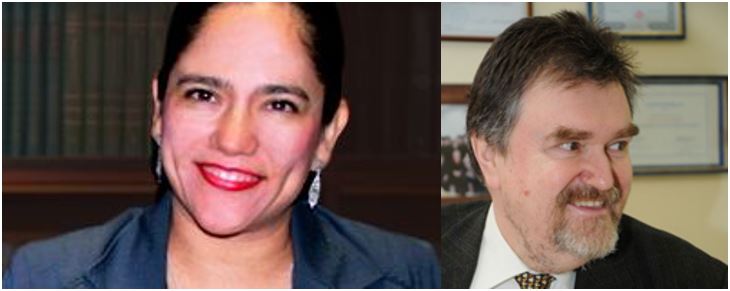
We are pleased to announce that Prof. Alexander Khoroshilov and Prof. María Soledad Ramírez Montoya, Keynote Speakers at UNESCO-UNIR ICT & Education Latam Congress 2016 (http://www.unesco-unir-latam.org).
Both are well-known worldwide as experts in Educational Technology and Innovation, and both are members of the most influential organizations in the field.
Maria Soledad Ramírez, and Alexander Khoroshilov. Keynote Speakers at UNESCO-UNIR ICT & Education Latam Congress 2016.
Alexander Khoroshilov is the Officer-in-Charge for UNESCO IITE (Institute for Information Technologies in Education, Moscow, Russia). He holds a PhD and is a well-known scientist and specialist on ICTs, mathematical modeling and statistics. He has over 40 years of deep professional experience in the field of ICTs and education (strategic development and management, capacity building and professional development, coordination of scientific-educational projects) including that at the international level.
María Soledad Ramírez Montoya is the director of the UNESCO Chair “Open Educational Movement for Latin America”, director of the International Council for Open of Distance Education (ICDE): OER Latin America office, lead researcher on the Strengthening Information Society Research Capacity Alliance (SIRCA) network, main organizer of the Regional Open Latin American Network for Social Research and Education (CLARISE) and coordinator of the Research and Innovation in Education Group (GIIE) at Tecnológico de Monterrey.
UNESCO-UNIR ICT & Education Latam Congress 2016 (http://www.unesco-unir-latam.org) is calling for papers for the conference to be held in Bogota, Colombia, from June 22nd to June 24th, 2016. Papers that examine the relationship between Technology & Learning, Educational Methodology, Educational Policy & Digital Society are encouraged to apply.
Submission
There are two types of contributions: 1. Scientific papers and 2. Workshops
Papers are accepted through EasyChair.com following these instructions:
Worshops will follow one or several of the main tracks of the Congress, and they will be submitted via EasyChair.com. The workshop proposals will provide specific details about objectives, target public, expected audience, technical requirements, links to any project or initiative, and other fields, to be filled in via this template.
Do not include author details, university or country information in the manuscript. This is a double-blind peer review process. Author information should be supplied using the manuscript submission form online or in the cover letter for email submissions
Please ensure all articles are proofread and checked for accuracy prior to submission. Changes cannot be made during the review process. If accepted, minor revisions may be made prior to final submission
Submission process will be managed via EasyChair.com
Presentations can be carried out in person or via streaming
Online participation will provide access to selected sessions
Certificates will be handed out for every presentation, with and indication about the channel (face-to-face, online)
Formatting Guidelines
Contributions must be in English and not more than 10 double column pages in length
Contributions must be original and relevant to one of the many conference topics
Authors are required to ensure accuracy of quotations, citations, diagrams, maps, and tables
Figures and tables need to be placed where they are to appear in the text and must be clear and easy to view
Prof. Dr. Alexander Khoroshilov is the Head a.i. of the UNESCO IITE. He holds a PhD and is a well-known scientist and specialist on ICTs, mathematical modeling and statistics. He has over 40 years of deep professional experience in the field of ICTs and education (strategic development and management, capacity building and professional development, coordination of scientific-educational projects) including that at the international level.
He was graduated from Moscow State University of Economics, Statistics and Informatics (MESI) in 1975, where he then worked until 2007 on various positions – from software engineer to First Vice-Rector. In the period from 2007 to 2010 he worked at Academy of Labor and Social Relations as Vice-Rector and at Moscow State (Lomonosov) University as professor. Since August 2010 he has been working at UNESCO Institute for Information Technology in Education (IITE) on the position of National Programme Officer responsible for teachers’ professional development based on ICT, OER and ICT competency standards as well as for networking and partnership with public and private sectors. Since December 2014 Professor Khoroshilov is Officer-In-Charge of IITE.
Abstract
“Reaching Targets of Education-2030. UNESCO Approach and IITE Activities”.
A generic UNESCO approach for achieving the UN Sustainable Development Goal 4 in the field of education – Ensure inclusive and equitable quality education and promote lifelong learning opportunities for all’ as well as appropriate targets which are detailed in UNESCO Framework for Action “Education 2030” will be presented in the context of impact of Information and Communication Technologies (ICT). ICT can contribute to universal access to education, equity in education, the delivery of quality learning and teaching, teachers’ professional development and more efficient education management, governance and administration.
UNESCO takes a holistic and comprehensive approach to promoting ICT in education. Access, inclusion and quality are among the main challenges they can address. ICT are very important by themselves but they must be tools to empower girls and boys, women and men, to provide equality, justice and dignity for all citizens of Inclusive Knowledge Societies.
To ensure that ICT must be integrated with curricula, learning environments, teacher professional development, educational resources and with pedagogy at whole. IITE as UNESCO Category 1 Institute fully responsible for ICT in education activities in UNESCO ecosystem has a nudge experience in the field of ICT-integrated pedagogy and teacher professional development based on ICT-competency models.
The main challenges of ICT-integrative pedagogy and a review of IITE best practice based on the cooperation with other UNESCO entities, Global UNESCO Networks and its partners from public and private sectors will be presented as well, along with information regarding Institute latest activities and plans.
Daniel Burgos, Vice-Chancellor for Research and Technology (UNIR Research, //research.unir.net), Director of the UNESCO Chair on eLearning and the ICDE Chair in Open Educational Resources, and General Chair of this Congress, welcomes you to participate in the Congress.
UNESCO Institute for Information Technologies in Education (IITE, http://iite.unesco.org, Moscow, Russia), Universidad Internacional de La Rioja (UNIR Research, //research.unir.net, Spain), and UNESCO Chair on eLearning at UNIR (//research.unir.net/unesco) are the organizers of this event to be held in Bogota, Colombia, from June 22nd to June 24th, 2016.
UNESCO-UNIR ICR & Education Latam Congress 2016 encourages project meetings and seminars related to their outcomes. The Congress will host, and provide logistics and technical facilities to research, development and innovation projects, from European Commission, Colciencias, research foundations, or any other working group across the World.
In addition, any seminar related to the project workplan (Kick-off meeting, pilots, training, etc.) or the disssemination of the outcomes will be welcome.
For more information and proposal, please contact the main office at u2016@unir.net, with the subject “Project Meeting”, and this filled-in template.
If you have an interest on education, in whatever form, do not miss what is going to happen on 22th, 23th and 24th June, 2016. If you have any input it will be welcome.
Under the online mode, the UNESCO Meeting proposes you to know first hand what Personalized Education experts do to meet the full training of each student in all its dimensions. We also encourage you to share with us your experience in the classroom, your opinions about what is and what is not to educate. Do not miss the opportunity to contribute to a better education.
If you believe you have something to say in this regard, if you do something in class that helps you to adjust to the characteristics and needs of your students or to encourage their collaborative spirit, share in this educational community; here you will find people like you exchanging concerns.
The meeting consists on the one hand in virtual classroom presentations that are carried out by experts in customization. Assistants will have the opportunity to participate in live discussions and other dialogues where researchers in the field will present their studies and experiences.